Last week, 512,000 lines of unobfuscated TypeScript leaked from an npm package. A missing `.npmignore` file. That's all it took.
Within hours, a developer rewrote the core architecture from scratch. Within a day, the rewrite hit 100,000 GitHub stars. 50,000 of those came in roughly two hours. The fastest-growing repository in GitHub history.
The narrative was immediate: "If this can be rebuilt so quickly, maybe there is no moat."
I've been building Prodini for two years. An AI-powered product management platform where context is everything. And when I watched this unfold, I didn't see a threat to software companies. I saw proof that the industry still confuses the recipe with the restaurant.
The Pattern Nobody Wants to Name
This isn't new. Every generation of software has a version of this moment.
In the early 2000s, Facebook's architecture was well understood. Dozens of clones launched. Friendster had the blueprint. MySpace had the users. None of it mattered. The product that won was the one that kept learning from behavior at scale.
Linux has been freely available since 1991. Red Hat built an empire on the exact same source code. IBM acquired them for $34 billion in 2019. Not for the code. For the accumulated decisions about what to patch, what to certify, what to support under production load.
The pattern is always the same. Code leaks or gets open-sourced. Clones appear. The original keeps winning. And people keep being surprised.
The Obvious Fix That Doesn't Fix Anything
The instinct is to lock things down. Better obfuscation. Stronger DRM. Tighter access controls.
But that misses the point entirely. The leaked architecture included agent loops, tool orchestration, CLI flows, file indexing patterns. All replicable. All visible in the rewrite.
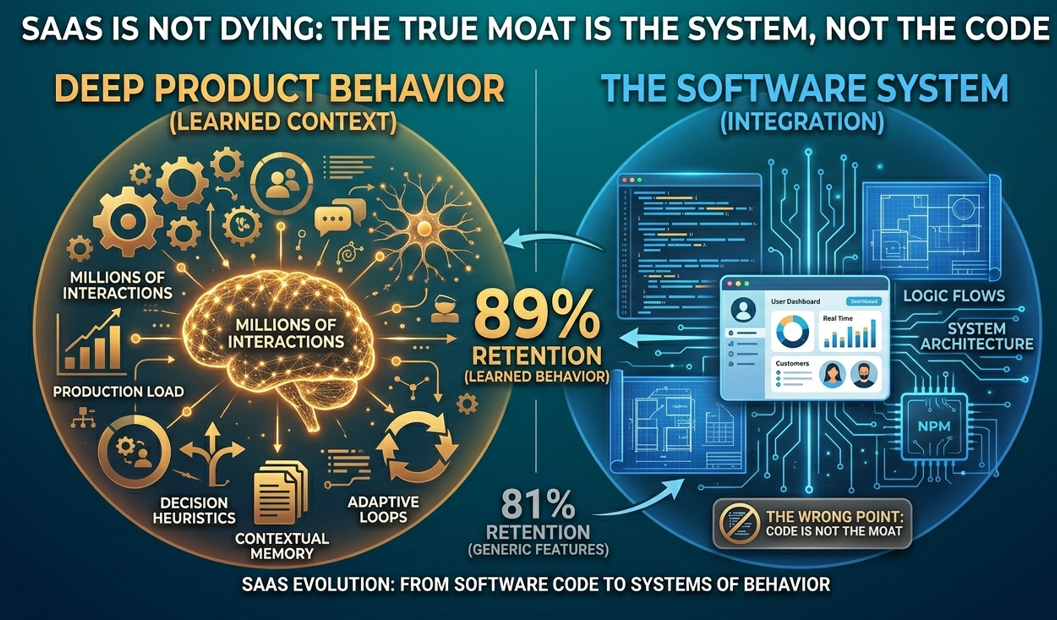
What it did not include: years of production behavior. Decision heuristics shaped by millions of real interactions. Context management that evolved through failure. The institutional memory of what broke and how the team adapted.
You can copy the shape of a system. You cannot copy its behavior.
Shape vs. Behavior: The Framework That Actually Matters
"The software slump is proving that code alone was never a real moat. The question is now: what's stopping someone from copying this next week."
That quote comes from a SaaS CEO during the February selloff, when major names dropped 5 to 10 percent in a single week. And he's right about the question. But the answer isn't what most people think.
McKinsey's 2025 AI survey found that 88% of organizations are using AI in at least one function. But only 31% have scaled it enterprise-wide. Nearly two-thirds of AI projects fail to move beyond the pilot stage.
If blueprints were enough, that number would be zero.
The real moat lives in what I call the behavior layer. It's the difference between knowing what a system does and understanding why it does it that way.
Software maintenance research consistently shows that 65 to 85 percent of total cost of ownership happens after launch. Building is the easy part. The expensive, difficult, unglamorous part is operating the system through every edge case, every failure mode, every user behavior you didn't predict.
The rewrite proved the architecture is copyable. It also proved, by contrast, everything that is not: the anti-distillation logic, the cryptographic reasoning chains, the autonomous agent memory systems with nightly consolidation loops. The shape was public. The behavior remains locked inside years of production learning.
What This Looks Like in Practice
Retention data tells the real story. Among AI coding tools, products that have embedded themselves deeper into team workflows retain 89% of users after 20 weeks. Tools with less context integration retain only 81%. The gap isn't features. It's accumulated understanding.
I've watched the same dynamic play out with product teams. A PM spends three hours explaining context to a new tool. The decisions, the tradeoffs, the reasons behind the spec. Then the tool generates something generic because it has no memory of what happened last sprint or why the team pivoted.
That's the difference between a system that was built and a system that has learned. The built system follows instructions. The learning system carries context forward.
GitHub Copilot holds 42% market share. Cursor captured 18% within 18 months. The winners aren't the ones with better architecture. They're the ones whose systems learned their users' codebases, patterns, and review conventions. That learning is non-transferable even if the architecture is public.
Why This Matters for How We Build
This is the lens behind Prodini. We didn't start by building features. We started by asking: what context gets lost every day between conversations, tools, and decisions?
The answer was: almost everything. Product decisions live in Slack threads that disappear. Requirements context exists in someone's head until they leave. The reasoning behind a spec is gone the moment the meeting ends.
We built a system that preserves decision context across tools and conversations. Not because the code is hard to write. Because the behavior of connecting fragmented knowledge into a continuous system is something that only emerges from operating in the real world, with real teams, over time.
The Real Takeaway
The fastest-growing repository in GitHub history proved something, just not what people think. It proved that building is approaching free. And that understanding, managing, and operating complex systems is where the real value now lives.
SaaS is not dying. It's evolving from software into systems of record and systems of behavior. The companies that win will not be the ones with the best code. They'll be the ones whose systems have learned the most.
If you're building in this space, I'd love to compare notes. Try Prodini or book a quick call to talk about how context engineering is reshaping product work.