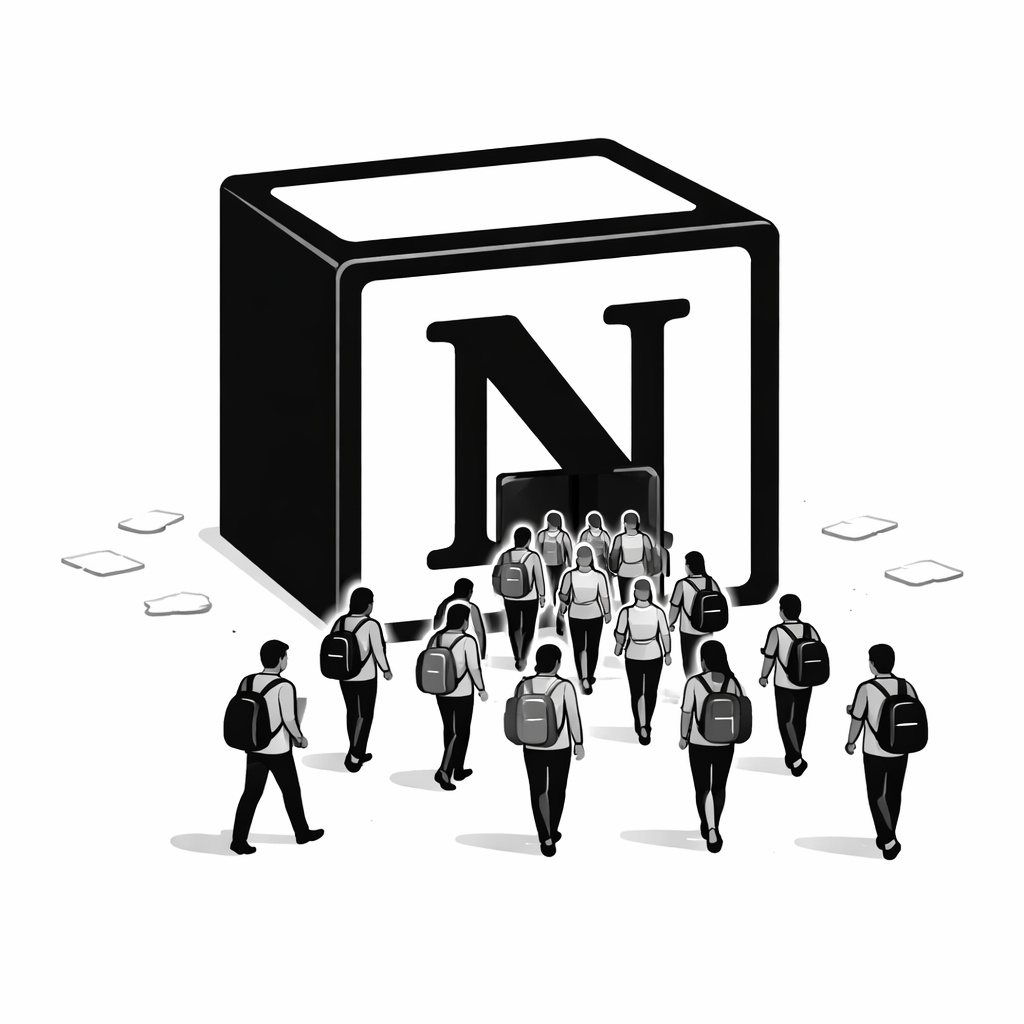
There's a version of this story that gets told in polite product circles.
It goes something like this: generative AI arrived, users got excited, companies rushed to integrate it, and Notion, being thoughtful and design-led, carefully layered AI into its product in a way that felt native and useful.
It's clean. It's flattering. It's also probably wrong.
Because companies like Notion don't wake up one morning and "decide to add AI." That framing is too shallow for a product that has spent years obsessing over structure, workflows, and user behavior at the level of individual keystrokes.
No, something else happened. Someone wrote a brief, someone argued over it, someone approved it, and eventually, after a lot of internal discomfort, someone shipped it.
I've spent time trying to reverse-engineer what that brief might have said. Not the marketing version. The real one. The one that circulated internally, full of constraints, tradeoffs, and uncomfortable truths.
Here's what I think it looked like.
The Problem Wasn't AI, It Was Leakage
Let's start with the part most companies get wrong.
The problem Notion was solving wasn't: "Users want AI features." That's a surface-level interpretation. The kind that leads to chatbots bolted awkwardly onto products that didn't ask for them.
The real problem was behavioral. Users were leaving. Not in the churn sense, not yet. But in the micro sense. The kind of leaving that doesn't show up in quarterly reports until it's too late.
A user is writing in Notion. They pause. They need help phrasing something, summarizing notes, generating ideas. So they open another tab > they go to ChatGPT > they do the work there > then, maybe, they come back. That "maybe" is everything!
Because every context switch is a crack in the product's surface. And cracks, left untreated, become exits.
If you're running product at Notion, you don't measure this as "AI demand." You measure it as context switching per session, dwell time fragmentation, how often users break flow.
And once you see it, you can't unsee it. The insight isn't "we need AI." It's: we're losing the moment of creation.
The KPI That Probably Didn't Make the Press Release
Publicly, AI launches are framed around adoption: number of users trying the feature, number of generations, engagement lift.
Internally, the KPI was likely more blunt: reduce context switching, keep the user inside the document, preserve flow.
Because Notion's real product isn't documents. It's thinking environments. And thinking doesn't tolerate friction well. Every time a user leaves to think somewhere else, Notion becomes a storage layer instead of a creation layer. That's an existential downgrade.
So the brief probably didn't say: "Build an AI assistant." It said something closer to: "Eliminate the need to leave." That's a very different mandate.
Why This Wasn't a Feature Decision
Most companies treat AI as a feature decision. Where does it live in the UI? What buttons trigger it? What templates does it support?
Notion couldn't afford to think that way. Because their product is already abstract. It's not a single workflow, it's a system for building workflows. Documents, databases, wikis, dashboards, all layered on top of each other.
Injecting AI into that environment isn't additive. It's invasive. If you do it wrong, you don't just add clutter. You break mental models.
And Notion's entire advantage is that its mental model, blocks, structure, composability, is surprisingly stable once you internalize it.
So the real question wasn't: "Where does AI go?" It was: "How do we introduce AI without collapsing the system users have already learned?" That's not a feature question. That's a systems question.
The First Real Decision: Who Is This For?
This is where most teams stumble. They launch to everyone, they assume more exposure equals more learning, and they end up burning trust with their most valuable users.
Notion likely did the opposite. They built for power users first. Not because power users are louder, though they are, but because they are more forgiving.
A power user understands the product's edges. They know what's supposed to happen and what isn't. They can tolerate a buggy v1 if the underlying direction feels right. A casual user doesn't have that context. For them, a broken AI interaction isn't "early-stage." It's just broken. And broken products get abandoned.
So the brief likely included an implicit segmentation: power users get early access with rough edges acceptable, everyone else gets delayed exposure with a higher bar for polish.
This isn't just about rollout strategy. It's about who gets to form the first opinion. Because first opinions, in product, tend to stick.
The Constraint Nobody Talks About
Every meaningful product decision has an invisible constraint. The one that doesn't make it into blog posts or launch videos because it sounds unglamorous.
For Notion, that constraint was probably this: "Must not break existing documents." It sounds obvious. It's anything but.
Notion documents are not static. They are deeply structured, interlinked, and often mission-critical. Teams run operations, roadmaps, and entire companies on top of them.
Introducing AI into that environment creates risk at multiple levels: structural corruption (formatting, blocks, references), semantic drift (AI rewriting content in ways that change meaning), and trust erosion (users unsure whether content is human or generated).
You can't treat that lightly. So every AI interaction had to be reversible, predictable, and non-destructive.
That's why, if you look closely, Notion's AI doesn't aggressively overwrite. It suggests, it inserts, it generates in contained spaces. It behaves less like an editor and more like a collaborator who knows their boundaries.
That's not accidental. That's constraint-driven design. And constraints like this slow you down, which explains something else people noticed at the time.
Why It Took Longer Than Expected
From the outside, it looked like Notion was late. Other tools were shipping AI features rapidly: chat interfaces, autocomplete, integrations. Notion moved more deliberately. That wasn't hesitation. It was friction.
Because layering AI onto a blank canvas product is harder than layering it onto a single-purpose tool. In a writing app, AI writes. In a design tool, AI generates visuals. In Notion, AI has to operate across everything, notes, tasks, databases, templates, without privileging one use case over another. And it has to do so without breaking the underlying abstraction.
That's a harder problem. So the delay wasn't about capability. It was about integration integrity. And integrity, in systems like this, is expensive.
The UI Problem: Invisible Until It Isn't
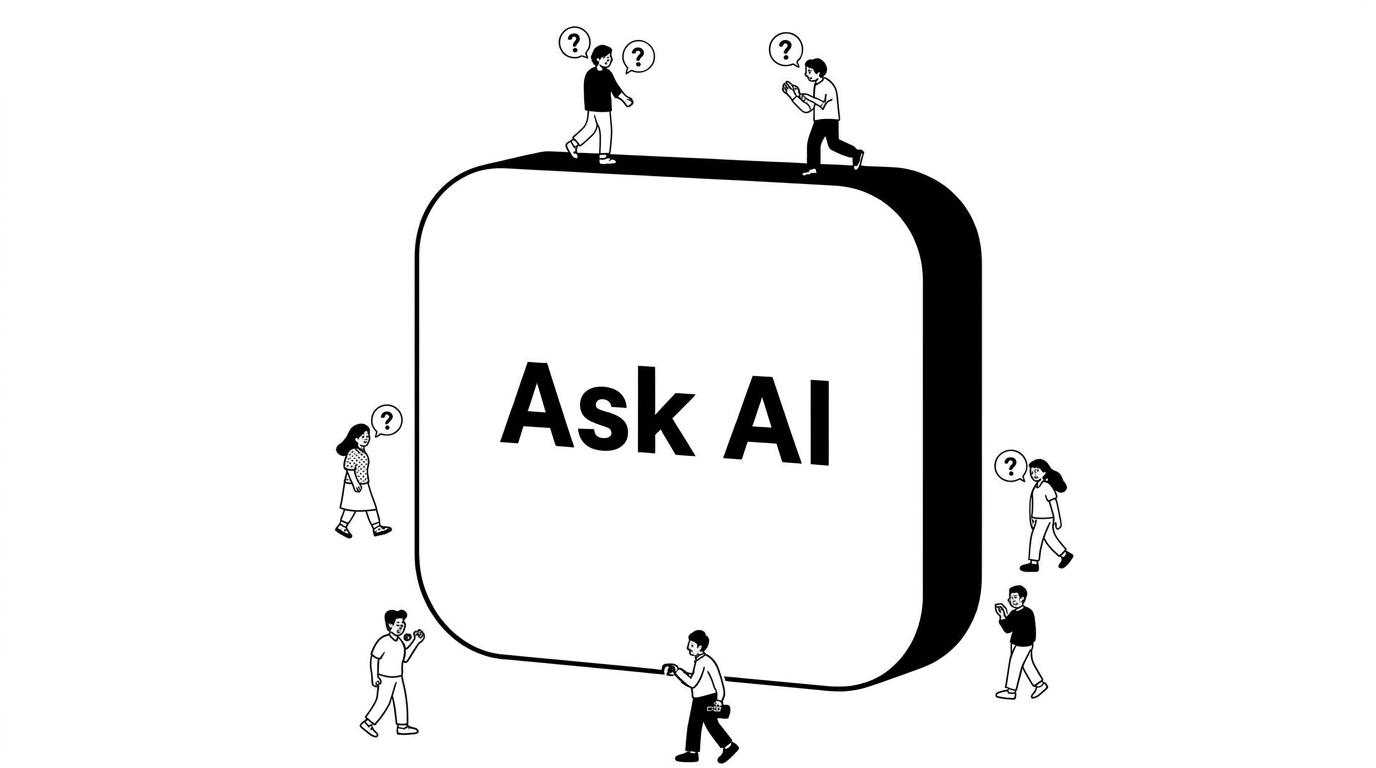
If you've used Notion AI, you'll notice something subtle. It doesn't scream for attention.
There isn't a giant "Ask AI" button dominating the interface. Instead, AI shows up contextually, as a slash command, a selection-based action, a quiet suggestion. That restraint is doing a lot of work.
Because the moment AI becomes the primary interface, the product risks collapsing into a chatbot. And Notion isn't a chatbot. It's a workspace. So the design challenge was to make AI available but not dominant, present but not intrusive, powerful but not destabilizing.
That's a narrow path. And it likely required multiple iterations to get right, each one balancing discoverability against disruption.
The Psychological Layer
There's another dimension here that doesn't get enough attention: user psychology. When you introduce AI into a tool people use for thinking, you're not just adding capability. You're altering behavior.
Users start to ask different questions: should I write this myself or let AI draft it? Is this idea mine or generated? Can I trust what's being suggested? These are not trivial concerns.
If mishandled, they can create hesitation, and hesitation is the enemy of flow. So Notion had to design not just for functionality, but for confidence.
That means: clear boundaries between user input and AI output, predictable behaviors, and easy undo and control mechanisms. In other words, the system had to feel safe. Not safe in a security sense, safe in a cognitive sense.
What They Didn't Do
Sometimes the most important product decisions are the ones you don't make. Notion didn't turn the product into a chat-first interface, force AI into every workflow, or optimize for novelty over stability.
These are tempting moves, especially in a fast-moving space. But they come at a cost. A chat-first interface would have simplified the AI story, but at the expense of the product's core structure. Aggressive AI insertion would have driven short-term engagement, but risked long-term trust. Notion chose restraint. That's harder to market. But often better for the product.
The Business Layer (Because It Matters)
Let's not pretend this was purely a product exercise. There's a business dimension here too. AI isn't just about retention. It's about monetization.
Features like Notion AI create opportunities for tiered pricing, usage-based billing, and differentiation in a crowded market. But those benefits only materialize if the feature is actually used. And usage, in this case, depends on integration. If AI feels bolted on, it gets ignored. If it feels native, it becomes habitual. So the product work, all the constraints, all the subtle design decisions, directly feeds the business outcome. That's the loop.
The Real Takeaway
It's easy to look at Notion AI and see a feature. It's harder, but more useful, to see the system behind it.
A system that starts with a behavioral insight: users are leaving > moves through a reframed problem: keep them in flow > defines a constraint: don't break what already works > chooses a user segment: start with those who understand the product best > and executes with restraint: integrate, don't dominate.
That's not a typical "AI story." It's a product story.
And the reason it matters is simple: most companies are still solving the wrong problem. They're asking: "How do we add AI?" When the better question is: "Where are we already losing the user, and can AI close that gap?"
Notion didn't just add AI. They went looking for a leak. And then they sealed it.